
2 Corinthians 11:23-33 (WEB)
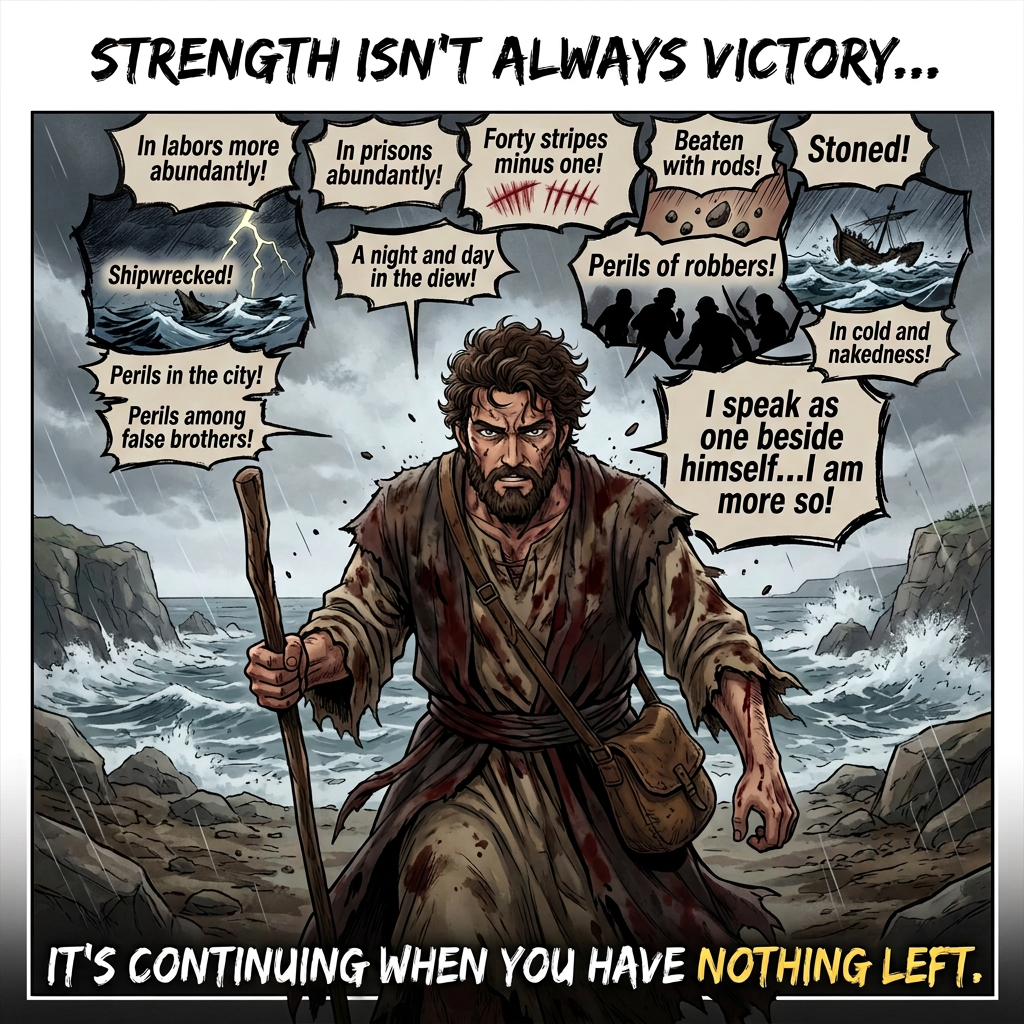
23 Are they servants of Christ? (I speak as one beside himself) I am more so; in labors more abundantly, in prisons more abundantly, in stripes above measure, in deaths often.
24 Five times from the Jews I received forty stripes minus one.
25 Three times I was beaten with rods. Once I was stoned. Three times I suffered shipwreck. I have been a night and a day in the deep.
26 I have been in travels often, perils of rivers, perils of robbers, perils from my countrymen, perils from the Gentiles, perils in the city, perils in the wilderness, perils in the sea, perils among false brothers;
27 in labor and travail, in watchings often, in hunger and thirst, in fastings often, and in cold and nakedness.
28 Besides those things that are outside, there is that which presses on me daily: anxiety for all the assemblies.
29 Who is weak, and I am not weak? Who is caused to stumble, and I don’t burn with indignation?
30 If I must boast, I will boast of the things that concern my weakness.
31 The God and Father of the Lord Jesus Christ, he who is blessed forever more, knows that I don’t lie.
32 In Damascus the governor under King Aretas guarded the Damascenes’ city, desiring to arrest me.
33 Through a window I was let down in a basket by the wall, and escaped his hands.
Here is a contemplation from someone anonymous.
As I was reflecting on 2 Corinthians 11:23–33, one thing struck me deeply: Paul shows us that true strength does not always look like victory, success, or triumph. Sometimes true strength looks like continuing when you have nothing left in yourself.
Paul speaks about imprisonment, beatings, dangers, hunger, thirst, cold, shipwrecks, and many other sufferings he endured because of Christ.
Yet he doesn’t share these things to exalt himself.
Quite the opposite.
Paul reveals his weakness.
And this is where something profoundly powerful is found.
The world says:
“Show your strength.”
Paul says:
“Look at my weakness—and see how faithful Christ is.”
Paul did not build his credibility on how impressive he appeared before people. He did not base his worth on comfort, success, or human approval.
His life became evidence that Christ remains faithful even when a person walks through the fire.
That struck me deeply.
Sometimes we can look at our own lives and ask:
“If God is really with me, why is this so difficult?”
But Paul’s life shows us that difficulty does not necessarily mean God is distant.
Paul was called by Christ.
- He loved Christ.
- He served Christ.
- And yet he suffered.
That means suffering itself is not proof that God has abandoned us.
Sometimes it is in the darkest valley that we discover just how faithful our Saviour truly is.
Paul also speaks about the burden he carried daily—the concern he had for other believers.
This shows us that his suffering did not make him indifferent.
Quite the opposite.
His own experiences enabled him to understand the weakness of others more deeply.
He did not look down on someone who was suffering.
He could say:
“Who is weak, and I am not weak?”
This is a picture of ministry born not from pride, but from grace.
Paul knew what weakness felt like.
- He knew fear.
- He knew danger.
- He knew deprivation.
- He knew what it meant to depend completely upon God.
And therefore his life pointed not to Paul, but to Christ.
What particularly moves me is the final part of this passage.
Paul does not describe some spectacular victory.
He doesn’t say that he defeated his enemies.
He doesn’t say that he escaped in a way that looked impressive.
He was lowered through an opening in the wall in a basket.
A basket.
It almost sounds humiliating.
And yet that is where we see God’s deliverance.
Paul survived.
God preserved his life.
And Paul was able to continue preaching Christ.
That reminded me that God’s victory does not always look the way we imagine victory should look.
Sometimes we expect God to open great doors before us.
And He simply gives us strength to walk through the small ones.
Sometimes we expect a spectacular miracle.
And God simply carries us through another day.
Sometimes we expect Him to remove the problem.
And He gives us grace to walk through the problem with Him.
Sometimes victory looks like a great triumph.
And sometimes victory looks like surviving by the grace of Christ.
And this is why Paul could later say:
“My grace is sufficient for you, for my power is made perfect in weakness.”
— 2 Corinthians 12:9 (WEB)
That changes the way we look at our weakness.
Weakness does not have to be the place where everything ends.
It can become the place where we truly discover the sufficiency of Christ.
- When I have no strength left—Christ is my strength.
- When I cannot see the way forward—Christ is my way.
- When I don’t know what to do—I can trust Him.
- When my abilities come to an end—His grace does not.
- When my hands can no longer hold everything together—Christ can still hold me.
And perhaps this is one of the most beautiful lessons in this passage.
- I don’t have to prove that I am strong.
- I don’t have to pretend that everything is fine.
- I don’t have to hide my weakness from God.
I can come to Christ exactly as I am.
- Tired.
- Wounded.
- Afraid.
- Uncertain.
- Weak.
Because the gospel does not say:
“Become strong enough, and then come to Jesus.”
The gospel says:
“Come to Jesus—and trust Him.”
Paul did not boast because weakness itself was something glorious.
He boasted in his weaknesses because his weakness pointed to the One who was his strength.
Paul was not the hero of the story.
Christ was.
And that is why 2 Corinthians 11:23–33 reminds me that my suffering does not have to be the end of my story.
My weakness does not have to become my identity.
My failure does not have to become my future.
My difficult circumstances do not mean that God has abandoned me.
If Christ is with me, even a road through suffering can become a place where I discover His faithfulness.
Because sometimes God does not deliver us from the basket.
Sometimes He carries us through the basket.
But if Christ is with us, even the basket can become an instrument of God’s grace.
- Not my strength.
- Not my perfection.
- Not my achievements.
- Not my abilities.
CHRIST.
- His grace is sufficient.
- His power remains.
- His presence does not leave.
And when my strength runs out, I can discover something I may not have understood before:
Christ never needed me to be strong enough.
He simply asks me to trust Him.
And therefore I can keep going.
- Not because I understand everything.
- Not because everything is easy.
- Not because there is no pain.
But because Jesus Christ is faithful.
And if He is with me,
- my weakness is not the end.
- My story is not finished.
- Grace is still working.
- Christ is still leading.
- And hope is still alive.
If you want to know His salvation, being born again and follow Jesus Christ have a look at resources especially at “WHAT MUST I DO TO BE SAVED” and “HOW CAN I BE SURE I HAVE ETERNAL LIFE?” links and feel free to contact us using the contact information here.

Leave a Reply